Francis Harry Compton Crick was born on 8 June 1916 in Weston Favell, then a small village on the edge of Northampton. The son of a local boot and shoe manufacturer, Crick spent his formative years in the town before achieving global recognition as the co-discoverer of DNA's double helix structure.
A Northampton Childhood
Crick's early life was rooted firmly in the industrial heritage of Northamptonshire. His father, Harry Crick, co-managed a family boot and shoe factory on St Giles Street in the town centre alongside his brother. The business had been founded by Crick's grandfather, Walter Drawbridge Crick, a businessman and amateur geologist who corresponded with Charles Darwin and published several scientific papers on geology. Two new forms of gastropods are named after him.
The family home was in Weston Favell, though the exact address is not recorded in the historical record. Crick later recalled: "He was a successful businessman, as well as an amateur geologist and biologist. He published several scientific papers on geology."
School Days on Billing Road
At around age eight or nine, Crick transferred to the most junior form of Northampton Grammar School, now Northampton School for Boys, on Billing Road. His daily journey to school covered approximately 1.25 miles, taking him via Park Avenue South and Abington Park Crescent. He walked, rode the bus, and later cycled to school.
The school, founded in 1541, lists Crick among its notable former pupils. The family had no car; their garage was used instead for "amateur theatricals and chemical experiments," Crick later recalled.
The Uncle's Shed on Abington Avenue
It was not at school but in a garden shed on Abington Avenue that Crick's scientific education truly began. His uncle, Walter Crick, lived in a house on the south side of the avenue. At the bottom of his garden stood a shed where he taught young Francis to blow glass, conduct chemical experiments, and make photographic prints.
"He had a shed at the bottom of his little garden where he taught me to blow glass, do chemical experiments and to make photographic prints," Crick said of his uncle. These practical skills would prove foundational for his later laboratory work.
Religious Doubt and Scientific Curiosity
By about age 12, Crick informed his parents that he did not wish to attend church any further. He "preferred a scientific search for answers over religious belief." This early rejection of religious doctrine in favour of empirical inquiry signalled the intellectual path he would follow throughout his career.
Departure for London
In 1931, when Crick was 14, the family moved to London. Crick transferred to Mill Hill School in North London on a scholarship, where he studied mathematics, physics, and chemistry. On Foundation Day, 7 July 1933, he shared the Walter Knox Prize for Chemistry.
From Northampton to the Nobel Prize
Crick's scientific career would lead him to Cambridge, where in 1953, working with James Watson at the Cavendish Laboratory, he co-discovered the double helix structure of DNA. The pair, along with Maurice Wilkins, were awarded the 1962 Nobel Prize for Physiology and Medicine.
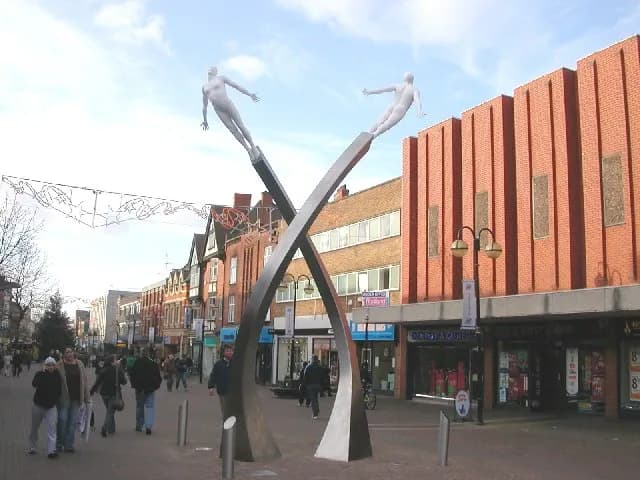
Francis Crick died on 28 July 2004 in San Diego, California, aged 88. A commemorative sculpture stands on Abington Street in Northampton, marking the town's connection to one of the 20th century's most significant scientific achievements.
Weston Favell, where Crick was born and raised, lists him as its most famous former resident. The journey from a garden shed on Abington Avenue to the discovery of life's fundamental building blocks remains one of Northampton's most remarkable stories.